
A Foreign Teacher Dismissed by Her Employer: Can She Claim Statutory Compensation in China? [Won Case]
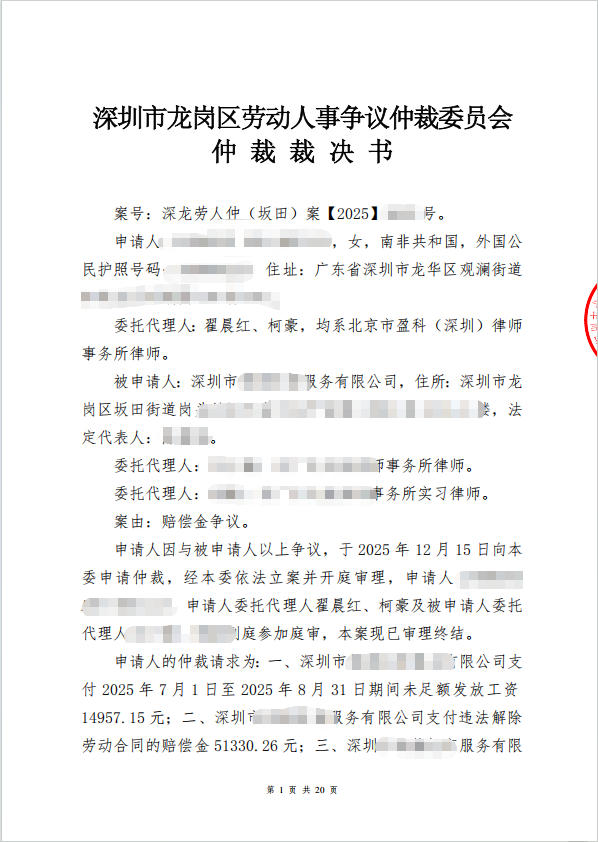
Outcome: The arbitral tribunal ordered the respondent to pay RMB 47,558.22 as compensation for unlawful termination of the labour contract, together with RMB 5,000 in legal fees
Region: Shenzhen, Guangdong Province | Deciding body: Longgang District Labour and Personnel Dispute Arbitration Commission of Shenzhen | Cause of action: Compensation for unlawful termination of a labour contractPeriod: 2025-2026 | Attorney: Zhai Chenhong、Ke Hao | Party: A South African foreign teacher (name changed)
1. Background
The client, a South African national, had worked since February 2025 as a lead foreign teacher at a childcare services company in Longgang, Shenzhen, on a monthly salary of approximately RMB 25,000. In November 2025 the employer served a Notice of Termination of the Labour Contract under Article 39 of the Labour Contract Law, relying on frequent use of a mobile phone while leading the class, frequent lateness and absence without leave, and terminated the contract unilaterally.
The client considered that these grounds could not stand, and instructed Zhai Chenhong of Yingke Law Firm (Shenzhen) to apply for arbitration before the Longgang District Labour and Personnel Dispute Arbitration Commission of Shenzhen.
2. Key difficulties and issues in dispute
The case presented three difficulties.
The employer produced three warning letters, surveillance footage, attendance records and training sign-in sheets, giving the appearance of serious misconduct.
The client was a foreign national with an objectively limited understanding of Chinese-language internal rules, a point which had to be evidenced and argued actively, since it would otherwise easily be overlooked at the hearing.
At the hearing the employer raised further defences — 111 days of cumulative lateness and concealment of illness on recruitment — seeking to widen the scope of review.
The issues in dispute were therefore: whether the grounds for termination held; whether the employer’s internal rules bound the client; and how the compensation base should be determined.
3. Counsel’s approach
Confine the scope of the termination: argue that the right to terminate is a formative right and that review is bounded by the grounds stated in the notice of termination at the time of service; the defences raised for the first time at the hearing were supplementary grounds added after the event and fell outside that scope.
Dismantle each of the three warning letters: as to mobile phone use, the employer had not previously enforced its phone-storage rule, its own management was defective, and there was no evidence of any further breach after the warning; as to lateness, rely on the employer’s own attendance rules, under which up to three instances a month and no more than 15 minutes in total require no payment, showing that the employer itself accepted that brief and infrequent lateness was not serious misconduct.
Develop the bilingual-publication duty: given the particular position of foreign workers, argue that an employer applying its internal rules owes a special duty to publish them bilingually and bring them effectively to the employee’s notice; Chinese-language training materials alone could not show that the rules had been effectively communicated.
Establish the compensation base: use bank transfer records whose authenticity both sides accepted, exclude amounts not so confirmed, and calculate the average monthly wage for the months before termination.
4. The tribunal’s findings
On mobile phone use, the tribunal held that surveillance footage alone could not show that the use was unrelated to teaching, nor was there evidence that it disrupted teaching order or created a safety risk; after receiving the warning letter the client had replied expressly and substantially reduced the frequency, so that the evidence was insufficient to establish subjective bad faith or persistent breach.
On lateness, the warning letters listed only a dozen or so instances of lateness of between one and nine minutes between April and September 2025, within the tolerance recognised by the employer’s own attendance rules, and not reaching a level of seriousness warranting termination.
On the single day of absence, the client had genuinely needed leave to attend a psychiatric outpatient appointment; although it was inappropriate not to state the reason clearly, this was consistent with the ordinary reasonable conduct of a natural person and caused no serious adverse consequences.
Crucially, the tribunal accepted counsel’s submission that an employer applying its internal rules to a foreign employee owes a special duty to ensure, by bilingual publication and effective notice, that the employee fully understands the meaning of the rules and the consequences of breaching them. Here the training materials were in Chinese only and there was no bilingual version, the procedure was defective, and the rules did not bind the client.
5. Outcome
The tribunal found that the termination of the labour contract on the grounds stated in the Notice of Termination lacked sufficient factual basis and valid regulatory support and constituted unlawful termination. The average monthly wage before termination was calculated at RMB 23,779.11 and, having regard to the length of service, the tribunal ordered the respondent to pay compensation for unlawful termination of RMB 47,558.22 (RMB 23,779.11 × 1 month × 2).
Under Article 58 of the Regulations of the Shenzhen Special Economic Zone on the Promotion of Harmonious Labour Relations, the tribunal also awarded RMB 5,000 in legal fees in proportion to the success of the claim. The remaining claims were dismissed.
6. Practical advice for foreign employees and employers
For foreign employees: on joining, ask for and keep a bilingual (Chinese and English) copy of the labour contract and staff handbook; if any part is unclear, ask the employer to explain it in writing and keep a record of the exchange.
For foreign employees: on receiving a warning or penalty notice, reply in writing setting out your objections and keep proof of delivery. Do not remain silent, or you may be taken to have accepted it by implication.
For employers: in the case of employees whose first language is not Chinese, internal rules must be published bilingually, explained clause by clause and acknowledged by signature, with the translation and training evidence retained. Otherwise it will be difficult to rely on them as a lawful basis for termination.
For employers: assess any termination carefully before proceeding — the grounds stated in the notice of termination set the boundary of review, and reasons added later will normally not be admitted.
Frequently asked questions on foreign-related labour disputes
Does Chinese labour law apply to foreign employees working in China?
Yes. Where a foreign national is employed in China and establishes a labour relationship with an employer, he or she is, unless the law provides otherwise, protected by the Labour Contract Law of the PRC and other laws and enjoys the same remedies as a domestic employee.
Is it valid for a company to discipline a foreign employee using a Chinese-only staff handbook?
There is a substantial risk. In practice, an employer applying its internal rules to an employee whose first language is not Chinese owes a special duty of bilingual publication and effective notice. In this case, with Chinese-only training materials and no bilingual version or clause-by-clause translation, the tribunal found that the rules did not bind the employee.
How is compensation for unlawful termination of a labour contract calculated?
It is twice the economic compensation standard. Economic compensation is one month’s wage for each completed year of service; monthly wage means the average wage over the twelve months before termination. Here, with an average monthly wage of RMB 23,779.11 and one month corresponding to the length of service, twice that amount is RMB 47,558.22.
Will an arbitral tribunal accept grounds for termination added later by the employer?
Generally not. The right to terminate is a formative right, and review is bounded by the grounds stated in the notice of termination at the time of service. Here the 111 days of cumulative lateness and the alleged concealment of illness raised at the hearing were not contained in the notice of termination and were treated as supplementary defences added after the event, outside the scope of review.
Can the company be ordered to pay the employee’s legal fees in labour arbitration?
In Shenzhen, yes. Under Article 58 of the Regulations of the Shenzhen Special Economic Zone on the Promotion of Harmonious Labour Relations, where an employee wins a labour dispute case, the legal fees paid may be borne by the employer, up to a maximum of RMB 5,000, any excess being borne by the employee.
Dismissed unfairly by your employer?
Compensation for unlawful dismissal · Rights of foreign employees · Unpaid wage claims · Nationwide practice
Tel / WeChat · +86 137 1519 9051
Email | yaozongxun@yingkelawyer.com
Facing a legal dispute and don't know how to resolve it? One-stop free legal consultation service
Divorce and asset division, child custody, unpaid wages, work injury compensation; contract breaches, unpaid debts, partnership disputes, corporate compliance; traffic accidents, real estate transactions, neighborhood torts, criminal cases and other legal issues — most people can't tell the right channels and end up taking detours and wasting money.
We have a dedicated team of lawyers covering all legal areas, with years of local practice and familiarity with courts and arbitration processes across Shenzhen's districts. We now offer a 24/7 free consultation channel — no barriers, no upfront fees:
✅ All case types covered: Marriage & Family | Labor Disputes | Loans & Debts | Real Estate & Construction | Commercial Contracts | Traffic Accidents | Criminal Defense | Corporate Legal Counsel
✅ All consultations free: case assessment, risk alerts, evidence guidance, process walkthrough, fee explanation — all at no charge
✅ Around-the-clock response: phone/WeChat available day, night, and holidays; urgent cases quickly matched with a lawyer
✅ Transparent and compliant fees: unified fee standards, all services itemized, no hidden charges, no bundling
✅ Dual-channel communication: consult online from home, or book an in-person meeting at our firm
We don't exaggerate outcomes or make improper promises. Based on the actual situation of your case, we provide objective, lawful, actionable solutions to help you avoid detours and minimize financial loss.
Have any legal questions? Contact a lawyer now for a free consultation!
E-mail: Consultation WeChat: 13715199051
Source: 姚宗勋 (www.yaozongxun.com) Please indicate the source when reposting.