
A Foreign Model Owed Fees by a Chinese Agency: Can She Sue in a Chinese Court? [Won Case]
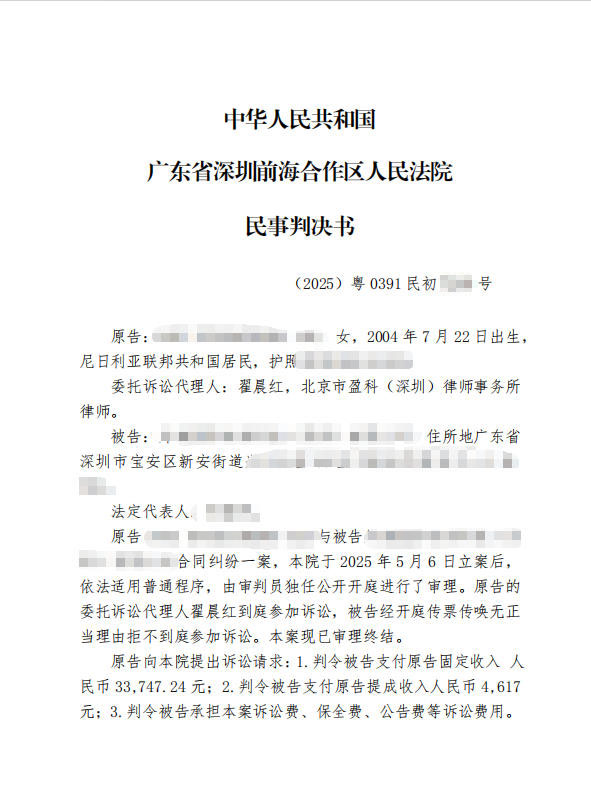
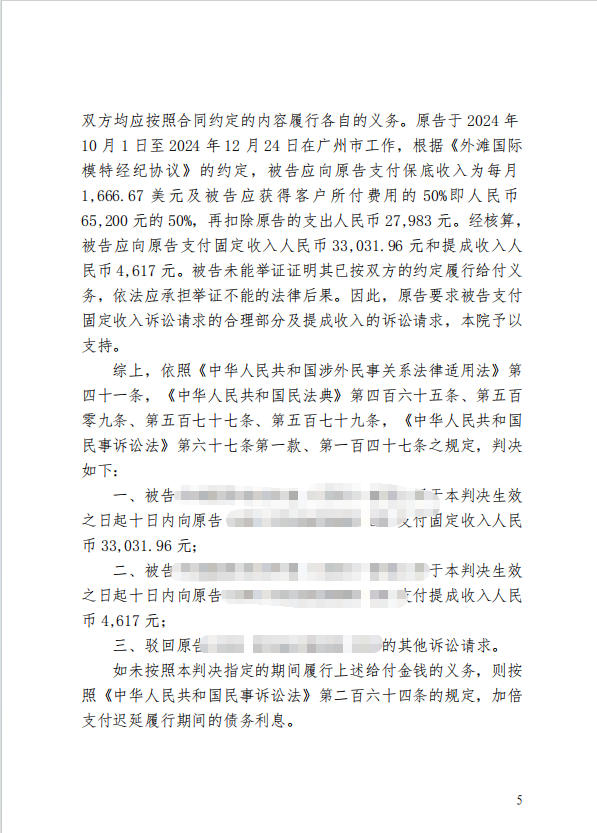
Outcome: The court ordered the defendant to pay RMB 33,031.96 in guaranteed income and RMB 4,617 in commission
Region: Shenzhen, Guangdong Province | Deciding body: Qianhai Cooperation Zone People's Court of Shenzhen | Cause of action: Foreign-related agency contract disputePeriod: 2025 | Attorney: Zhai Chenhong, Yingke Law Firm (Shenzhen) | Party: A Nigerian model (name changed)
1. Background
The client, a national of the Federal Republic of Nigeria, signed a Model Agency Agreement in September 2024 with an international fashion technology company in Shenzhen and its overseas parent company. Under the agreement the client was entitled to 50% of the fees paid by clients, together with a guaranteed monthly income of USD 1,666.67, payable in a single lump sum on the day before the client left China.
The client entered China and worked from 1 October to 24 December 2024. During that period she received no guaranteed income at all, and the commission was not settled either. After repeated attempts to resolve the matter without success, the client instructed Zhai Chenhong of Yingke Law Firm (Shenzhen) to bring proceedings before the Qianhai Cooperation Zone People’s Court of Shenzhen.
2. Key difficulties and issues in dispute
The case presented two difficulties.
The defendant company, although lawfully summoned by the court, refused to appear. The case therefore proceeded by default and the plaintiff had to close the evidential loop on every fact and every document on her own.
The contract did not choose a governing law, and the parties belonged to different jurisdictions, so the applicable law had to be determined first.
The issues in dispute were therefore: which country’s law applied; whether the agency agreement was lawful and valid; how the guaranteed income and commission should be calculated; and what consequences followed from the defendant’s failure to appear.
3. Counsel’s approach
Determine the governing law first: under the closest-connection principle, argue that the contract was performed in Guangdong Province and had the closest connection with mainland China, so that the law of the People’s Republic of China applied.
Reconstruct the performance in full: use entry and exit records, WeChat messages, work income statements and expense vouchers to fix the actual start and end of the work, the total income received and the deductible expenses, so that both the guaranteed income and the commission could be quantified.
Verify the originals: cooperate with the court in checking the original documents, so that the authenticity, legality and relevance of the evidence could still be accepted even though the defendant was absent and no cross-examination took place.
Delimit the claim: adjust the sums claimed of counsel’s own motion where the contract was unclear or the evidence did not support them, confining the claim to what could be granted and so increasing the proportion of the claim allowed.
4. The court’s findings
The court held that the plaintiff was a citizen of the Federal Republic of Nigeria and that the case therefore contained a foreign element. The parties had not chosen the applicable law by agreement, and the Model Agency Agreement was to be performed in Guangdong Province; applying the closest-connection principle, the governing law of the contract was the law of the People’s Republic of China.
The Model Agency Agreement signed by the parties was a genuine expression of intent and did not contravene mandatory provisions of law or administrative regulations; the contract was lawful and valid and both parties should perform it as agreed. The plaintiff had actually provided her services between 1 October and 24 December 2024, and the defendant should pay the guaranteed income and the commission calculated at 50% of the fees paid by clients, less the expenses which the plaintiff had agreed to bear.
The defendant did not appear to prove that it had performed its payment obligation, and it therefore bore the legal consequences of failing to discharge the burden of proof.
5. Outcome
Applying Article 41 of the Law of the People’s Republic of China on the Application of Laws to Foreign-related Civil Relations, Articles 465, 509, 577 and 579 of the Civil Code, and Articles 67(1) and 147 of the Civil Procedure Law, the court ordered the defendant to pay the plaintiff RMB 33,031.96 in fixed income and RMB 4,617 in commission, and dismissed the plaintiff’s other claims. The case acceptance fee was shared between the parties in proportion to the success of the claim.
6. Practical advice for foreign professionals and agencies
For foreign professionals: when signing, ask for the contract in bilingual or native-language form, specifying the composition of the remuneration, the time of payment, the deductible items and the means of dispute resolution.
For foreign professionals: keep work records, payment records and correspondence throughout. These are the only basis on which a claim can be pursued across borders after you have left China.
For agencies: substituting “cash payment before departure” for normal settlement both increases your own risk of breach and may raise compliance issues. Monthly settlement by bank transfer, with vouchers retained, is preferable.
For agencies: do not ignore a claim that has been brought against you. A default judgment places the burden of proof on the plaintiff alone, and the defendant will almost certainly lose.
Frequently asked questions on foreign-related contract disputes
Can a foreign national sue in a Chinese court?
Yes. Foreign nationals, stateless persons, foreign enterprises and organisations bringing or defending an action in a Chinese court enjoy the same litigation rights and obligations as Chinese citizens, legal persons and other organisations. It is sufficient to complete the notarisation and legalisation of the party’s corporate documents under the foreign-related procedure in order to file the case.
If a foreign-related contract does not choose a governing law, which law will the court apply?
Under Article 41 of the Law on the Application of Laws to Foreign-related Civil Relations, where the parties have made no choice, the law of the habitual residence of the party whose performance is most characteristic of the contract applies, or the law most closely connected with the contract. Here, because the contract was performed in Guangdong, the court applied Chinese law.
Can the court still give judgment if the defendant does not appear?
Yes. Where a defendant has been lawfully summoned and refuses to appear without justified reason, the court may give judgment by default. The plaintiff must nevertheless discharge the entire burden of proof, and the authenticity, legality and relevance of the evidence must be confirmed by the court against the originals.
How are guaranteed income and commission determined?
On the basis of the contract, taking account of the actual period of performance, the income actually received and the agreed deductions. Here the court applied the guaranteed standard of USD 1,666.67 per month, prorated to the days actually worked, and deducted the expenses which the plaintiff had agreed to bear, in order to arrive at the sum payable.
What can be done if the defendant does not pay after judgment takes effect?
The plaintiff may apply to the court for compulsory enforcement once the judgment has taken effect. If the defendant has assets within China, they may be sealed, frozen and transferred directly; if the assets are abroad, recognition and enforcement may be sought under a judicial assistance treaty between China and the relevant country, or on the basis of reciprocity.
Let down by a contract counterparty?
Foreign-related contract review · Cross-border recovery of fees · Default judgment · Nationwide practice
Tel / WeChat · +86 137 1519 9051
Email | yaozongxun@yingkelawyer.com
Facing a legal issue? Explain your situation clearly first — then decide whether you need a lawyer.
Criminal cases turn on evidence and timing; divorce and family matters on property and children; commercial disputes on contracts and performance. Different situations call for very different approaches.
Tell us the type of case, the amount involved, and where things stand — and we'll give you a free initial assessment.
E-mail: yaozongxun@yingkelawyer.com Consultation WeChat: 13715199051